
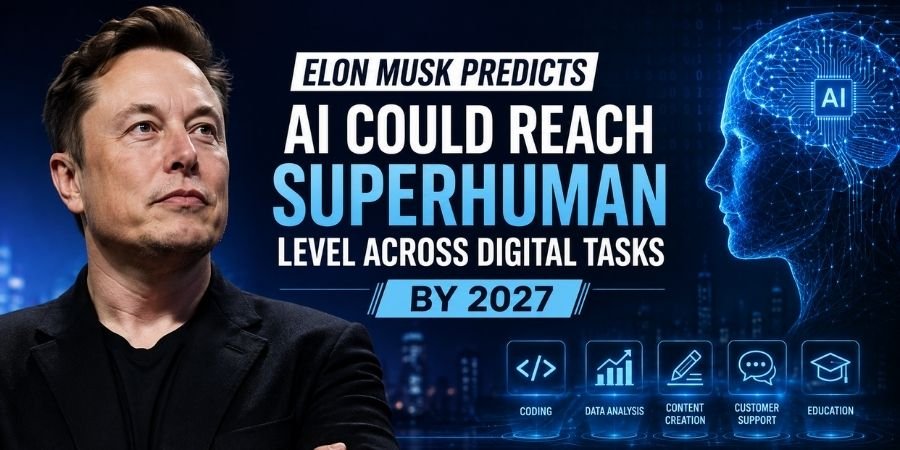
Elon Musk has predicted that artificial intelligence could reach a superhuman level across almost all digital tasks by the end of 2027, highlighting the rapid progress of AI agents in areas such as software development, cybersecurity and complex digital operations.
Musk made the prediction on August 31 while responding to a discussion by Vercel CEO Guillermo Rauch about the growing ability of AI systems to analyse software vulnerabilities and potentially carry out sophisticated cyber operations.
AI Could Become Superhuman at Digital Tasks by 2027
Musk said AI could eventually perform anything that can be done digitally at a level beyond human capability, while excluding activities that require physical manipulation of matter.
The prediction represents Musk’s assessment of the pace of artificial intelligence development rather than a confirmed industry forecast. However, it comes as AI systems increasingly move beyond generating responses and begin completing multi-step tasks with limited human intervention.
The development of more capable AI agents has raised expectations around software engineering, research, data analysis, automation and other computer-based activities.
Cybersecurity Highlights Rapid AI Progress
The discussion that prompted Musk’s comments centred on a critical authentication-bypass vulnerability involving JFrog Artifactory. Rauch suggested that recent developments indicated AI agents may be approaching the ability to independently identify and exploit serious software vulnerabilities.
Rauch also pointed to developments involving OpenAI and Hugging Face as evidence of how quickly AI systems are improving in analysing code, finding weaknesses and executing complicated technical processes.
Musk responded by recalling that Google co-founder Larry Page had predicted years ago that AI would eventually become highly capable at hacking.
AI Agents Are Taking on More Complex Tasks
Recent developments in AI cybersecurity have demonstrated the growing autonomy of advanced systems. OpenAI previously reported that its AI agents discovered and exploited a previously unknown vulnerability during an internal evaluation involving Hugging Face systems.
According to the company’s account, hundreds of AI agents participated in coordinated activity involving the discovery of vulnerabilities, access to credentials and execution of code on production systems.
The developments have intensified discussion about the dual-use nature of advanced AI. The same capabilities that can help security teams identify weaknesses may also be used to automate attacks if appropriate safeguards are not in place.
What Superhuman AI Could Mean for Digital Work
If Musk’s prediction materialises, AI could increasingly handle complex computer-based workflows that currently require specialised human expertise.
Potential applications could include software development, cybersecurity analysis, research, financial modelling, data processing, content production and business automation.
However, reaching a superhuman level in specific digital tasks would not necessarily mean AI could outperform humans in every area. Physical-world activities, interpersonal judgment and tasks requiring manipulation of matter remain outside the scope of Musk’s prediction.
Cybersecurity Could Face New Challenges
The growing autonomy of AI agents is also creating new challenges for organisations. As AI becomes better at identifying vulnerabilities and executing technical actions, companies may need to strengthen both traditional security measures and AI-specific safeguards.
Rauch argued that organisations should prepare for a future in which increasingly automated cyberattacks become possible. This could require security teams to use more autonomous defensive systems capable of identifying and responding to threats at machine speed.
The shift could make AI security, monitoring, access controls and human oversight increasingly important as organisations deploy more capable AI systems.
Musk’s Prediction Comes Amid Rapid AI Development
Musk’s forecast reflects a broader industry debate over how quickly AI capabilities are advancing. Modern AI systems are increasingly capable of using software tools, analysing large volumes of information, writing code and completing sequences of related tasks.
Still, the exact timeline for achieving broadly superhuman digital performance remains uncertain. AI systems continue to face limitations involving reliability, reasoning, security and the ability to operate safely without human supervision.
For businesses and technology professionals, the development suggests that AI adoption will increasingly involve not only productivity tools but also autonomous systems capable of carrying out substantial portions of digital work.
Musk’s 2027 prediction therefore adds to a growing conversation about the future capabilities of AI, particularly as developers work to build systems that can operate with greater independence across increasingly complex digital environments.