
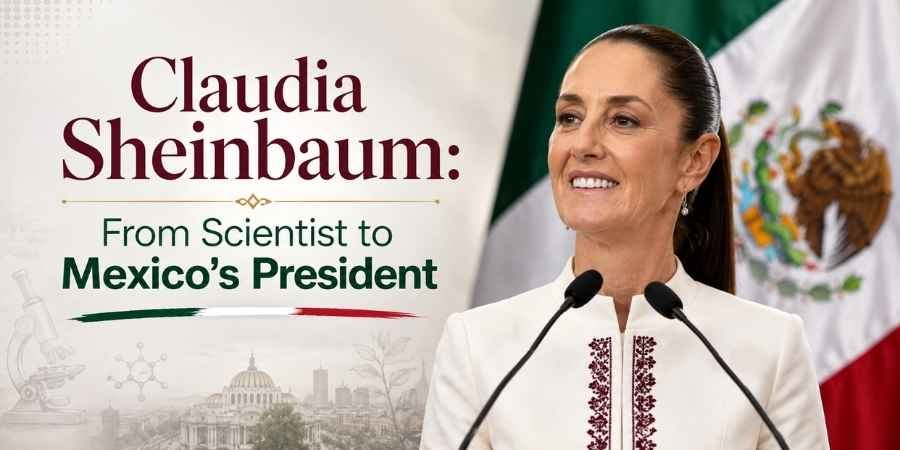
Claudia Sheinbaum Pardo became Mexico’s 66th president on October 1, 2024, after winning the 2024 presidential election by a historic margin. She became the first woman to hold Mexico’s presidency and the first president of Jewish ancestry, marking a major transformation in the country’s political history. Her six-year term followed the presidency of Andrés Manuel López Obrador and placed a climate scientist and former Mexico City mayor at the center of national power.
Who is Claudia Sheinbaum?
Claudia Sheinbaum is a Mexican scientist and politician who became president after building a career that combined academic research, climate policy, and government leadership. Born in Mexico City in 1962, she studied physics and later earned advanced degrees in energy engineering. Her scientific background distinguished her from many traditional political leaders and shaped her focus on energy, climate change, infrastructure, and evidence-based public policy.
Before becoming president, her major roles included:
- Climate scientist: She worked as an academic and researcher specializing in energy and environmental issues.
- International climate expert: She participated in the Intergovernmental Panel on Climate Change, which shared the 2007 Nobel Peace Prize.
- Mexico City official: She served as mayor of Mexico City from 2018 to 2023.
- National political leader: She became the presidential candidate of the ruling Morena movement for the 2024 election.
Her transition from academia to politics took decades rather than happening overnight. Reuters described her presidential journey as a four-decade progression from scientific work into public administration and national politics.
How did Claudia Sheinbaum become Mexico’s president?
Claudia Sheinbaum won Mexico’s June 2, 2024 presidential election by a landslide, securing roughly 60% of the vote and defeating her closest rival by more than 30 percentage points. The result gave her a strong electoral mandate and made her the first woman elected president in Mexico’s history. She also received the highest number of votes ever recorded by a presidential candidate in the country.
Her campaign represented continuity with the political movement established by López Obrador while also presenting her own professional identity.
Key factors behind her victory included:
- Strong support for Morena and its social programs.
- The popularity of López Obrador among significant sections of the electorate.
- Her experience governing Mexico City.
- A campaign focused on social welfare, economic development, and public investment.
- Her image as a scientist with government experience.
Her victory was particularly significant because Mexico had only granted women the federal vote in 1953. More than seven decades later, a woman reached the highest elected office in the country.
Why was her inauguration historically significant?
Her October 1, 2024 inauguration was historic because she became both Mexico’s first female president and the first person of Jewish ancestry to occupy the presidency. She assumed office for a constitutionally mandated six-year term, succeeding López Obrador. Her Jewish heritage comes through her family background, including grandparents who came to Mexico from Eastern Europe after fleeing persecution.
The significance extended beyond gender and heritage. Her presidency also represented the arrival of a scientist at the highest level of Mexican government.
At her inauguration, Sheinbaum emphasized that her victory represented Mexican women collectively rather than only herself. The Mexican government described her as a mother, grandmother, scientist, and woman of faith while emphasizing the start of a new stage in the country’s political transformation.
What are Claudia Sheinbaum’s main political priorities?
Claudia Sheinbaum has emphasized social welfare, economic development, public infrastructure, security, energy policy, and the continuation of the political transformation associated with Morena. Her government has also placed particular attention on women’s rights, education, housing, healthcare, and programs aimed at lower-income communities.
Her administration inherited several major challenges:
| Policy area | Major challenge |
|---|---|
| Security | Organized crime, violence, and high homicide levels |
| Economy | Maintaining growth while managing public finances |
| Energy | Balancing state energy companies with investment and transition goals |
| Social policy | Expanding welfare programs while maintaining fiscal sustainability |
| Justice | Implementing controversial judicial reforms |
| U.S. relations | Managing trade, migration, security, and diplomatic ties |
Security became an especially urgent issue after she took office. Her administration announced a strategy emphasizing greater coordination among federal and state authorities and targeted action in areas heavily affected by organized crime.
Judicial reform has also been one of the most consequential issues surrounding her administration. She supported reforms that included the popular election of judges, a proposal that generated significant debate about judicial independence and the balance of power among Mexico’s institutions.
What makes her leadership different?
Her scientific training gives her leadership profile a distinctive foundation, particularly on climate, energy, and environmental policy. Before entering national politics, she developed expertise in energy engineering and climate science, making her one of Mexico’s most academically credentialed modern political leaders.
Her experience as Mexico City’s head of government also provided practical executive experience before the presidency. During that period, she became associated with policies involving transportation, infrastructure, environmental measures, and public security.
That combination—scientific expertise, municipal administration, and national political experience—helped define her public image. Reuters noted that her Mexico City administration had been associated with a significant reduction in the city’s homicide rate, although national security challenges remained considerably broader.
What does her presidency mean for Mexico?
The presidency of Claudia Sheinbaum represents a historic shift in Mexican politics because it combines the country’s first female presidency with a new chapter in the Morena political movement. Her election also demonstrates the growing influence of women in Mexican political institutions, where women have increasingly occupied major legislative, judicial, and executive positions.
Her administration is expected to be judged on whether it can preserve popular social programs while addressing fiscal pressures, security concerns, energy challenges, and institutional debates.
The first year of her administration highlighted priorities including welfare programs, security, economic policy, education, infrastructure, healthcare, housing, and women’s rights. Mexico’s presidency reported these areas as central components of the government’s first-year agenda.
Frequently Asked Questions
When did Claudia Sheinbaum become president of Mexico?
Claudia Sheinbaum became president of Mexico on October 1, 2024, after winning the June 2, 2024 presidential election. She succeeded Andrés Manuel López Obrador and began Mexico’s constitutionally mandated six-year presidential term.
Is Claudia Sheinbaum Mexico’s first female president?
Yes. Claudia Sheinbaum is Mexico’s first elected female president. Her inauguration on October 1, 2024, marked the first time a woman assumed Mexico’s presidency through a national presidential election.
Is Claudia Sheinbaum Jewish?
Sheinbaum is of Jewish ancestry through her family, although her Jewish background is primarily described in terms of heritage and family origins. Her grandparents came to Mexico from Eastern Europe, and her election made her the first person of Jewish ancestry to become president of Mexico.
How long will she serve as president?
Mexico’s president serves a single six-year term and cannot be immediately reelected. Sheinbaum’s presidential term began on October 1, 2024, and is scheduled to run through September 30, 2030.
Conclusion
Claudia Sheinbaum’s rise from climate scientist and Mexico City mayor to the nation’s 66th president is one of the most consequential political transformations in modern Mexican history. Her presidency broke a longstanding gender barrier while bringing a leader with a scientific background and Jewish ancestry to Mexico’s highest elected office. Her lasting legacy will depend on how effectively she balances social priorities, economic growth, security, energy policy, and institutional reform.