
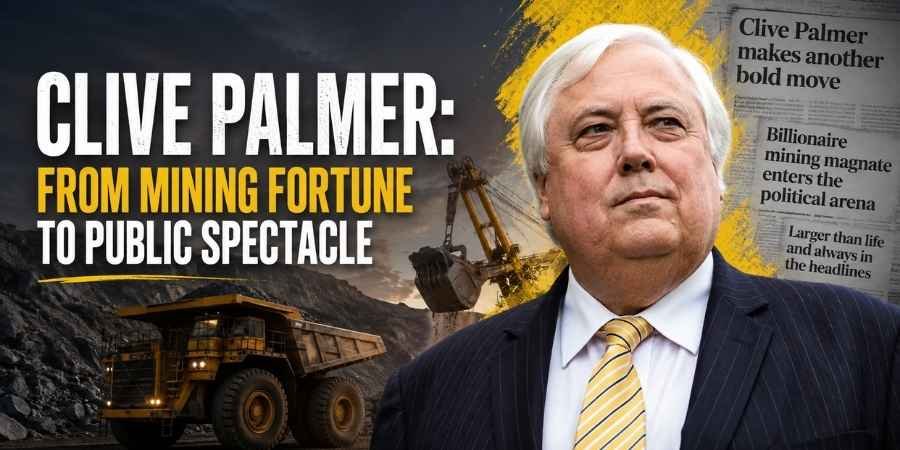
Clive Palmer is an Australian billionaire businessman, mining magnate, former federal politician, and founder of Mineralogy, whose fortune has been built largely around iron ore assets and royalties in Western Australia’s Pilbara region. Forbes currently estimates his real-time net worth at about US$4.1 billion, placing him among Australia’s wealthiest individuals.
Born in Melbourne in 1954, Palmer initially built wealth through property development before turning his attention to mining. He established Mineralogy in 1984, and the company eventually became the central vehicle for his resources empire.
His business career has included:
- Iron ore and mineral exploration
- Coal projects
- Nickel processing
- Oil and gas interests
- Property and tourism
- Political campaigning
- Luxury and heritage projects
The combination of resource wealth, aggressive legal strategies and highly visible personal projects has made Palmer one of Australia’s most recognizable—and controversial—business figures.
How did Clive Palmer build his fortune?
Clive Palmer built his fortune primarily through Mineralogy’s Pilbara iron ore interests and long-term royalty arrangements connected to mining operations. His major breakthrough came from acquiring magnetite tenements at Cape Preston and later reaching an agreement with Chinese company CITIC Pacific over mining rights.
The Pilbara assets became extraordinarily valuable because they generated royalties without requiring Palmer’s company to operate every part of the mining process itself.
A key part of the business model involved:
- Mineralogy: Palmer’s flagship private resources company.
- Pilbara iron ore: The foundation of much of his wealth.
- CITIC relationship: Mining rights were transferred under arrangements involving substantial upfront payments and ongoing royalties.
- Diversification: Palmer expanded into coal, nickel, hydrocarbons and other investments.
Mineralogy’s financial performance illustrates the scale of these assets. ABC reported that the company generated $730.9 million in revenue in one financial year, including approximately $520 million in royalties, much of it linked to CITIC Pacific Mining’s magnetite operations in the Pilbara.
More recently, royalty income has fluctuated because of disputes and production issues surrounding the Pilbara operations. That volatility highlights an important feature of Palmer’s wealth: although diversified, a significant portion remains closely connected to resource assets and royalty flows.
What is Clive Palmer’s net worth?
Clive Palmer’s estimated net worth is approximately US$4.1 billion as of August 2026, according to Forbes, although billionaire wealth estimates can change with asset valuations, royalty income, legal outcomes and private-company performance.
His wealth is difficult to measure with the precision possible for publicly traded-company founders because many of his major holdings are privately controlled.
| Wealth driver | Importance |
|---|---|
| Mineralogy | Core business and asset-holding company |
| Pilbara iron ore royalties | Major source of recurring wealth |
| Coal and resource assets | Diversification within mining |
| Property and other investments | Additional wealth base |
| Private-company holdings | Makes exact valuation difficult |
Forbes notes that Palmer became a billionaire in 2019 after court action helped restore the flow of iron ore royalties to Mineralogy.
Why is Clive Palmer so famous for politics?
Clive Palmer became a major political figure after winning the Queensland seat of Fairfax in 2013 and serving in the Australian House of Representatives until 2016. He founded and led the Palmer United Party, using a significant portion of his personal wealth to finance political campaigns.
His political spending became extraordinary by Australian standards.
During the 2019 federal election campaign, Palmer’s political operation spent more than $80 million, while in 2022 his United Australia Party spending exceeded $120 million. Australia’s parliamentary research records show that Mineralogy donated $117 million to the UAP during the 2022 campaign.
Despite the enormous expenditure, the electoral returns were limited:
- 2019: UAP received about 3.4% of the national primary vote and won no House seats.
- 2022: The party received about 4.7% nationally and secured one Senate seat.
- The campaign became a major case study in the influence—and limits—of money in Australian politics.
This combination of personal wealth and political spending established Palmer as a distinctive figure in Australian public life.
What is Titanic II and why did Palmer build it?
Titanic II is Palmer’s proposed modern replica of the RMS Titanic, designed to reproduce the original ship’s appearance and passenger experience while incorporating contemporary safety, navigation and engineering standards. The project was launched through Palmer’s Blue Star Line, which was registered in 2012.
The project reflects Palmer’s reputation for turning unconventional ideas into high-profile commercial ventures.
According to Blue Star Line, Titanic II is planned to feature:
- A layout inspired by the original Titanic
- Recreated interior spaces
- Modern safety systems
- Contemporary navigation technology
- First-, second- and third-class accommodation
- A route inspired by Titanic’s original Southampton-to-New York voyage
Blue Star Line has said the project is being revived after delays, with a proposed maiden voyage in June 2027 and an estimated construction cost of roughly $500 million to $1 billion.
Whether the ship ultimately enters commercial service remains one of the most closely watched questions surrounding Palmer’s business projects.
What legal controversies has Clive Palmer faced?
Clive Palmer’s business career has been marked by major legal disputes involving mining royalties, government legislation, corporate affairs and international claims. One of the most significant recent disputes involved his attempt to pursue a multibillion-dollar claim against the Western Australian government over the Balmoral South iron ore project.
In 2025, an international tribunal dismissed his foreign-investor claim, and Palmer was ordered to pay approximately $13.6 million. The dispute followed Western Australian legislation designed to prevent him from pursuing damages connected to the Pilbara project.
His history also includes the collapse of Queensland Nickel, the nickel and cobalt refinery business he acquired in 2009. The company entered voluntary administration in 2016 before being liquidated.
These episodes demonstrate the two sides of Palmer’s business model: extraordinary gains from resources, alongside substantial corporate, political and legal risks.
What makes Clive Palmer different from other billionaires?
Clive Palmer stands out because he combines mining wealth with political activism, legal battles and highly unconventional personal projects on a scale rarely seen among Australian billionaires. His career moves repeatedly between resource extraction, public policy, litigation and headline-making ventures such as Titanic II.
His story illustrates how a private mining fortune can influence multiple areas of public life:
- Business: Mineralogy and resource royalties.
- Politics: Self-funded political parties and campaigns.
- Law: High-value disputes involving governments and corporations.
- Entertainment and tourism: Titanic II and other ambitious projects.
- Collectibles: Large-scale investments in luxury and vintage assets.
The result is a business biography that is as much about ambition and risk-taking as it is about wealth.
Frequently Asked Questions
Is Clive Palmer a billionaire?
Yes. Forbes currently estimates Palmer’s real-time net worth at approximately US$4.1 billion, although the figure changes as private assets and business interests are reassessed.
How did Clive Palmer make his money?
His fortune was built primarily through mining and resource investments, particularly Mineralogy’s Pilbara iron ore interests and associated royalty arrangements with mining operators.
Is Titanic II actually being built?
Titanic II remains an active project promoted by Blue Star Line, with the company saying it has re-engaged partners after earlier delays. A maiden voyage has been proposed for June 2027, although completion and commercial launch are not guaranteed.
How much money did Palmer spend on politics?
His political campaigns have involved exceptionally large sums. Mineralogy donated $117 million to the United Australia Party for the 2022 federal election campaign, while total UAP spending exceeded $120 million.
Conclusion
Clive Palmer’s journey from property development to a multibillion-dollar mining fortune has been defined by resource wealth, aggressive business strategies and an appetite for ambitious projects. His Pilbara royalties created the financial foundation, while politics, litigation and Titanic II transformed him into a uniquely recognizable public figure.
For readers tracking Australian billionaires, mining wealth or unusual business ventures, Palmer’s career offers a compelling example of how enormous resource fortunes can extend far beyond traditional corporate investment.