
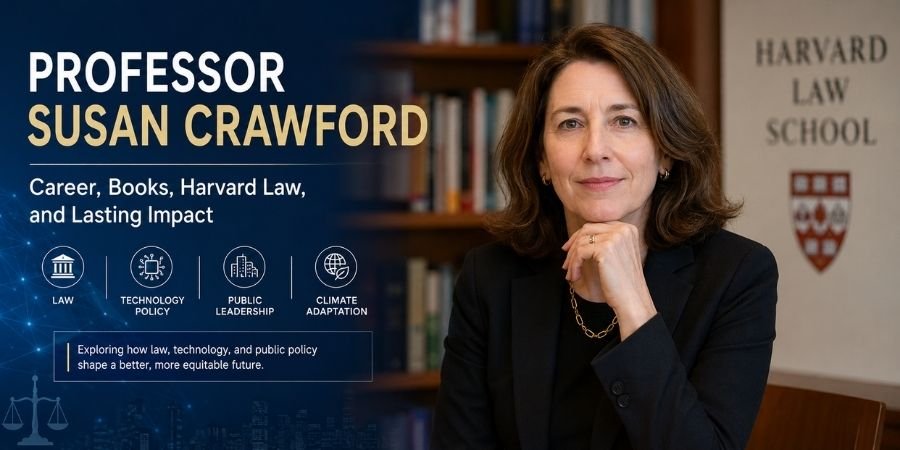
Professor Susan Crawford has built a distinctive career at the intersection of law, technology, public policy, communications, and climate adaptation. Best known for her work at Harvard Law School, Crawford has also served in the Obama administration, advised on broadband and technology policy, written influential books, and contributed to public discussions about how technology and infrastructure affect society.
What makes Professor Susan Crawford particularly notable is the breadth of her work. Rather than treating technology as a purely technical subject, she has consistently examined its relationship with law, economics, government, cities, and social equity. Her career offers a useful example of how legal expertise can influence some of the most important policy questions of the digital age.
Who Is Professor Susan Crawford?
Professor Susan Crawford is an American legal scholar and author whose work has focused on telecommunications, information law, technology policy, public leadership, and climate adaptation. Harvard Law School identifies her as the John A. Reilly Clinical Professor of Law, Emeritus. She has also taught and worked across several Harvard institutions and has been involved in major discussions surrounding Internet access and public policy.
Her professional background extends beyond academia. Professor Susan Crawford served as Special Assistant to President Barack Obama for Science, Technology, and Innovation Policy in 2009 and co-led the Federal Communications Commission transition team during the change from the Bush administration to the Obama administration. Earlier, she worked as a partner at the law firm Wilmer, Cutler & Pickering, now WilmerHale.
Professor Susan Crawford’s Education and Early Career
Professor Susan Crawford earned both her Bachelor of Arts and Juris Doctor degrees from Yale University. After law school, she clerked for Judge Raymond J. Dearie of the U.S. District Court for the Eastern District of New York. She later practiced law at Wilmer, Cutler & Pickering before moving into legal academia.
Her transition from legal practice to teaching helped shape the multidisciplinary approach that later became a defining part of her career. She taught at institutions including Cardozo School of Law and the University of Michigan Law School before becoming closely associated with Harvard’s technology, law, and public-policy community. Harvard Law School appointed her to its full-time faculty in 2015 after she had served as a visiting professor.
Professor Susan Crawford at Harvard Law School
At Harvard Law School, Professor Susan Crawford became known for examining the practical consequences of technology and communications policy. Her academic work has explored areas such as Internet law, communications law, city technology, public leadership, and climate adaptation. Harvard’s case-study resources also document her work on technology, cities, leadership, and governance.
One important feature of Professor Susan Crawford’s academic approach is her interest in how infrastructure affects ordinary people. Her work on broadband access, for example, has connected questions about Internet infrastructure with economic opportunity, social justice, and civic participation. In 2016, Harvard highlighted her Responsive Communities Initiative, which focused on social justice, civil liberties, economic development, high-speed Internet access, and government use of data.
Professor Susan Crawford and Technology Policy
Technology policy has been one of the strongest themes throughout Professor Susan Crawford’s career. Her government experience gave her a direct view of how technology decisions are shaped by institutions, regulators, and public priorities. Her work has often challenged readers to think about who benefits from digital infrastructure and who may be left behind.
Her book Captive Audience: The Telecom Industry and Monopoly Power in the New Gilded Age examines competition and power in the telecommunications industry. She later wrote FIBER: The Coming Tech Revolution—and Why America Might Miss It, which explores the importance of high-speed fiber infrastructure and the consequences of inadequate broadband investment.
Why Her Broadband Work Matters
Broadband is no longer simply a convenience. Reliable Internet access increasingly affects education, employment, healthcare access, entrepreneurship, government services, and participation in modern society.
Professor Susan Crawford’s work is valuable because it places broadband within that larger context. Instead of viewing connectivity only as a consumer service, she has examined it as infrastructure with economic and social consequences. That perspective remains relevant as communities continue investing in faster and more resilient digital networks.
Professor Susan Crawford’s Books and Publications
Writing has been another major part of Professor Susan Crawford’s professional influence. Her publications translate complex legal and policy issues into arguments that can be understood by academics, policymakers, journalists, and general readers.
Some of her best-known books include:
- Captive Audience: The Telecom Industry and Monopoly Power in the New Gilded Age
- The Responsive City: Engaging Communities Through Data-Smart Governance, co-authored with Stephen Goldsmith
- FIBER: The Coming Tech Revolution—and Why America Might Miss It
- Charleston: Race, Water, and the Coming Storm
Her most recent book listed by Harvard is Charleston: Race, Water, and the Coming Storm, published in 2023. The book examines Charleston’s development, racial history, environmental vulnerability, and the growing challenge of climate-related flooding.
Professor Susan Crawford and Climate Adaptation
In the later phase of her career, Professor Susan Crawford expanded her public-policy work toward climate adaptation and the future of vulnerable cities. Her writing has increasingly examined how communities can respond to rising seas, flooding, infrastructure risks, and the financial challenges associated with climate adaptation.
This shift is significant because it builds on themes already present in her earlier work. Whether the subject is broadband or climate resilience, Crawford’s central concern is how infrastructure, government decisions, and public resources shape people’s lives. Her work encourages policymakers to consider long-term consequences rather than focusing only on immediate development goals.
Professor Susan Crawford’s Major Achievements
Professor Susan Crawford’s career includes academic, government, legal, and public-service achievements. She served on the board of directors of ICANN from 2005 to 2008 and founded OneWebDay, an annual event focused on celebrating and thinking about the Internet.
Her influence has also been recognized by major publications and organizations. Harvard notes that she has been named among TIME’s Tech 40, Fast Company’s Most Influential Women in Technology, Prospect Magazine’s Top Ten Brains of the Digital Future, and Politico’s 50 Thinkers, Doers and Visionaries Transforming Politics.
What Can We Learn From Professor Susan Crawford’s Career?
Professor Susan Crawford’s career demonstrates that professional influence does not have to remain within one discipline. Her experience combines law, academia, government, technology, telecommunications, city policy, and climate adaptation.
Three lessons stand out:
- Build expertise across disciplines. Crawford’s work shows the value of connecting law with technology, economics, and public policy.
- Focus on real-world consequences. Her research repeatedly asks how infrastructure and policy decisions affect communities.
- Keep adapting. Her transition from telecommunications policy toward climate adaptation demonstrates the importance of responding to emerging challenges.
Professor Susan Crawford Net Worth: What Is Known?
Questions about Professor Susan Crawford’s net worth appear online, but there is no reliable, authoritative public source that establishes a verified personal net-worth figure. Harvard Law School’s official biography provides extensive information about her education, career, publications, and public service, but it does not publish a net-worth estimate.
For that reason, assigning a specific dollar amount would be speculative. A trustworthy biography should distinguish between verified professional information and financial claims that cannot be independently confirmed. Professor Susan Crawford’s documented contributions to law, technology policy, public service, and climate research are more meaningful indicators of her professional legacy than an unsupported wealth estimate.
Frequently Asked Questions About Professor Susan Crawford
Who is Professor Susan Crawford?
Professor Susan Crawford is an American legal scholar, author, and public-policy expert associated with Harvard Law School. Her work covers technology, telecommunications, Internet law, public leadership, and climate adaptation.
What is Professor Susan Crawford known for?
She is particularly known for her research and writing on broadband infrastructure, telecommunications policy, technology law, and the relationship between infrastructure and public policy.
Did Professor Susan Crawford work for President Obama?
Yes. In 2009, Professor Susan Crawford served as President Barack Obama’s Special Assistant for Science, Technology, and Innovation Policy. She also co-led the FCC transition team between the Bush and Obama administrations.
What books has Professor Susan Crawford written?
Her notable books include Captive Audience, FIBER, and Charleston: Race, Water, and the Coming Storm. She also co-authored The Responsive City with Stephen Goldsmith.
Where did Professor Susan Crawford study?
She earned both her B.A. and J.D. from Yale University.
What is Professor Susan Crawford’s current academic status?
Harvard Law School currently lists Professor Susan Crawford as the John A. Reilly Clinical Professor of Law, Emeritus.
What is Professor Susan Crawford’s connection to climate policy?
Her more recent academic and writing work has focused substantially on climate adaptation, coastal communities, rising seas, infrastructure, and the legal and financial challenges of preparing cities for climate change.
What is Professor Susan Crawford’s net worth?
There is no reliably verified public figure for Professor Susan Crawford’s personal net worth. Published estimates should therefore be treated cautiously unless supported by credible financial documentation.